
9 Ecommerce Gamification Ideas Chosen by Campaign Goal
 By Haroon Haneef · Published · 10 min read
On this page
- Start with the shopper problem
- 1. Use a recommendation quiz when choice is the obstacle
- 2. Use a scratch card when the offer is already decided
- 3. Use a catch game for a short seasonal burst
- 4. Use memory match when recognition has a job
- 5. Use a poll when the customer needs a quick route
- 6. Use a cart progress challenge only with an honest threshold
- 7. Use missions for repeat behaviour, not endless chores
- 8. Use referral milestones when the reward follows a valid outcome
- 9. Use a hunt or jigsaw when exploration is the point
- Certain rewards are often easier to trust
- Run the India dark-pattern check before launch
- Run one clean test and measure the hand-offs
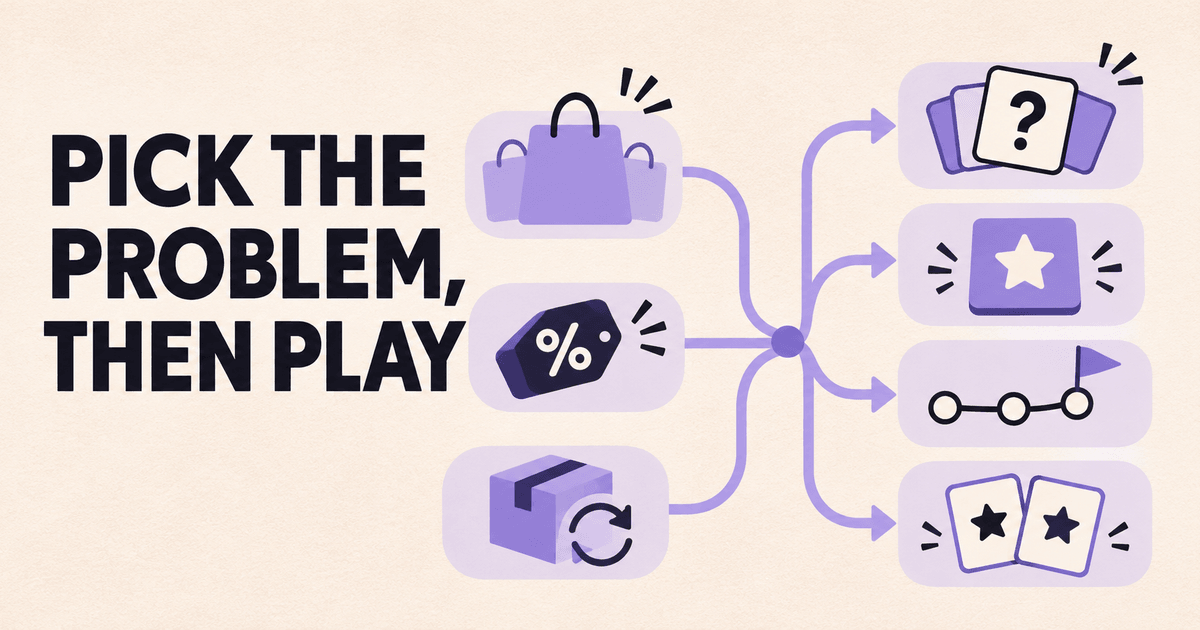
Choose an ecommerce game by the shopper problem, not by which animation wins the meeting. Use a quiz for product choice, a reveal for a timely offer, a challenge for active attention, and a progress system for repeat behaviour. Before launch, connect the mechanic to one reward, channel, success metric, operating burden and trust check.
Start with the shopper problem
Fill the blank with an observable action: view a suitable product, submit a useful preference, redeem an offer, add an item, return or refer someone. “Engage with the brand” is too foggy to measure and too convenient to defend after the numbers arrive.
The research does not support treating gamification as a universal sales switch. A systematic review of 80 articles published from 2000 to 2024 found that psychological, emotional and contextual factors shape the customer experience; its broad scope also means it does not prescribe one winning ecommerce mechanic. Treat the game as a design choice to test, not a promise.
Use this shortlist before the detailed ideas:
| Shopper problem | Funnel goal | Mechanic | Reward | Suitable channel | Primary metric | Burden |
|---|---|---|---|---|---|---|
| Too many similar products | Discovery | Recommendation quiz | Useful result; optional certain offer | Product or category page | Result-to-product click rate | Medium |
| Offer is being ignored | Lead capture or conversion | Scratch card | Clearly stated coupon | Landing page, email or WhatsApp link | Qualified redemption rate | Low |
| Seasonal campaign needs attention | Awareness or conversion | Catch game | Coupon or occasional product prize | Social, email, SMS or WhatsApp link | Completion-to-next-step rate | Medium |
| Products or benefits are unfamiliar | Education | Memory match | Result or relevant offer | Product page or event | Product-page continuation rate | Medium |
| Customers need a quick choice | Discovery | Poll | Result or tailored route | Website or email | Result-to-route click rate | Low |
| Cart value needs a nudge | Conversion | Progress challenge | Certain benefit at a disclosed threshold | Cart | Threshold completion rate | Medium |
| Repeat purchase has gone quiet | Retention | Missions | Progress and earned benefit | Account, email or WhatsApp | Mission completion and repeat purchase | High |
| Advocates need a reason to share | Referral | Milestone referral | Certain reward after a valid milestone | Account or post-purchase message | Valid referred customers | High |
| A launch needs active exploration | Discovery | Find-the-item or jigsaw | Early access or relevant offer | Campaign page | Completion-to-product click rate | Medium |
1. Use a recommendation quiz when choice is the obstacle
A recommendation quiz fits a catalogue where shoppers need help selecting among meaningful options. Ask only questions that change the result, explain why the suggested product fits, and lead directly to the relevant product or collection page.
The reward can be the recommendation itself. If you add a coupon, prefer a clearly described offer over a mysterious prize when certainty supports the shopper’s decision. Research comparing certain and chance-based monetary rewards on a real ecommerce website shows that reward structure can affect behaviour, but its findings concern monetary designs and should not be stretched into a rule for every branded game.
Measure result-to-product clicks first, then add-to-cart and purchase for the recommended route. Implementation is medium: the difficult part is not drawing the quiz; it is maintaining accurate question-to-product logic as the catalogue changes.
2. Use a scratch card when the offer is already decided
A scratch card works when the campaign has a clear reveal and every participant can understand what happens next. It is suitable for lead capture or conversion only when the prize rules, validity, inventory and redemption route are settled before launch.
Place it on a campaign page or share its link through an owned channel. GameOn Brands says its customised games can be embedded on a website and distributed through website popups, email, SMS and WhatsApp. Measure qualified redemptions rather than email volume alone; a long list of people who wanted a discount but never became customers is not a loyalty programme in disguise.
The setup burden is low relative to a custom arcade game, but fulfilment can become the real project. Show the outcome immediately and do not hide conditions behind the reveal.
3. Use a catch game for a short seasonal burst
A catch game suits a seasonal campaign that needs active attention for a brief period. Make the objects relevant to the product or occasion, keep the round short, and send the player to one useful next action.
This mechanic carries more production and testing work than a reveal. Test touch targets, low-end phones, loading time, every score state and the closed-campaign screen. The primary metric should connect completion to the next step, such as a product-page visit or valid redemption, rather than rewarding the team for accumulating plays.
Shineherbs used Catch the Goodies in an RMH GameOn campaign. The founder of Shineherbs says the campaign produced a high coupon conversion rate cost-efficiently, but no numerical result has been provided. That makes it a useful format example, not a benchmark.
4. Use memory match when recognition has a job
Memory match fits product education when pairing items, ingredients, uses or benefits helps the shopper notice something relevant. It does not fit when the cards are merely repeated logos. Remembering where a logo was hidden is a rather expensive lesson in where a logo was hidden.
Gramiyum used Match the Card in an RMH GameOn campaign. The founder of Gramiyum says website conversion increased by 50% after adding gamification; this is a founder-reported testimonial with no supplied comparison period or measurement method, so it does not prove the game caused the change. Haroon Haneef worked at Gramiyum from December 2018 to December 2019, and Gramiyum is now a GameOn client.
For a new campaign, measure whether completers continue to the products or information featured in the pairs. Burden is medium because the card logic is simple but the content, accessibility, mobile interaction and post-game route still need care.
5. Use a poll when the customer needs a quick route
A poll is the lightest choice when one preference can lead the customer somewhere useful. It can route shoppers by flavour, use case, style or shopping occasion without pretending that a single answer is a scientific profile.
The result should change the next screen. If every answer reaches the same generic category page, the poll has collected data without repaying the participant’s effort. Measure clicks from each result to its matching route and compare whether those visits produce meaningful product interactions.
Setup burden is low, but data governance still matters. Collect only what you can explain and use. GameOn Brands lists Poll among its available formats, alongside quizzes, puzzles, reveals and arcade-style games.
6. Use a cart progress challenge only with an honest threshold
A progress challenge can make a disclosed cart benefit easier to understand: show the customer how close the current basket is to a valid reward and what qualifies. This is a conversion tool, not permission to manufacture pressure.
Keep the threshold and benefit stable, show exclusions before the customer invests effort, and update progress accurately when quantities change. Measure how many eligible carts cross the threshold, alongside margin, cancellations and returns. A higher order value that creates unprofitable fulfilment is a colourful accounting problem.
Implementation is medium because the interface must reflect live cart rules. The mechanic should never add an item, subscription or consent by default.
7. Use missions for repeat behaviour, not endless chores
Missions suit retention when customers have several useful actions to complete over time: learning how to use a product, returning for a replenishment check or exploring a relevant range. Each mission needs a clear action, progress state, benefit and end condition.
A field study of one large European e-tailer’s programme examined operational data around points, missions and collectible badges to assess behaviour and revenue. Its single-retailer setting limits generalisation, but the measurement approach is the useful lesson: evaluate commercial behaviour as well as activity inside the programme.
This is a high-burden mechanic. It requires identity, persistent progress, customer support and rules for reversals or missing events. Start with one short mission rather than building a small constitutional system for points.
8. Use referral milestones when the reward follows a valid outcome
A referral milestone fits existing customers who have a credible reason to recommend the product. Define the valid outcome—such as a completed first order—then award the benefit after that event, not after a click or a freshly typed email address.
Measure valid referred customers, cost per valid referral and subsequent purchase quality. Add fraud checks and a visible status so the advocate knows whether the referral qualified. The implementation burden is high because attribution, returns, duplicate identities, reward delivery and support all need rules.
Avoid forced sharing, preselected contacts or copy that promises a reward before the qualifying action. A recommendation should remain a customer choice, not an obstacle course placed in front of checkout.
9. Use a hunt or jigsaw when exploration is the point
A find-the-item game or jigsaw can support a launch when the campaign wants shoppers to inspect products, packaging or a visual story. Make the clues relevant and keep the path short. If the participant can finish without noticing the product, the mechanic has completed the wrong job very efficiently.
Use a campaign page reached from social or owned messages, then lead to the featured product. Measure completion-to-product clicks and later product actions. Burden is medium: creative production, responsive interaction, clue testing and accessibility take more work than the finished game suggests.
GameOn Brands lists Find Me and Jigsaw among its formats. That availability does not decide whether they fit; the shopper problem and next action do.
Certain rewards are often easier to trust
RMH’s documented campaigns used coupon codes from 5% to 50%, with occasional free products. Those are examples of reward ranges RMH has used, not a recommendation for every margin or audience.
The three campaign records also have different evidence limits. Amma Samayal used a Scratch Card, but RMH has provided no conversion, redemption or sales result for that campaign. Shineherbs has a qualitative founder testimonial without a numerical result. Gramiyum has a founder-reported number without a measurement method or comparison period. Preserve those distinctions when deciding what the examples can teach.
For a first test, a certain, modest benefit is usually easier to explain and operate than a large chance-based prize. That is a recommendation, not a research finding. If chance is central to the idea, disclose the possible outcomes and do not make the losing state feel like a trick.
Run the India dark-pattern check before launch
India’s Central Consumer Protection Authority guidelines apply to specified dark patterns across ecommerce and other online interfaces; an official parliamentary answer identifies practices including false urgency, forced action, interface interference, drip pricing and nagging. Have counsel check the final campaign, offer and terms. This article is general information, not legal advice.
Review every screen:
- Is the end time real, and does it remain consistent?
- Can the customer dismiss the game without repeated prompts?
- Are price, eligibility, expiry and redemption conditions visible before commitment?
- Does any option, consent or item appear selected by default?
- Does the result screen deliver what the rules led the participant to expect?
- Can a person reach support and understand what data was collected?
Run one clean test and measure the hand-offs
Write a one-page campaign brief before production: shopper problem, audience moment, intended next action, mechanic, reward, channel, primary metric, guardrail metrics, owner and stop date. Keep the first test narrow enough that the result can change a decision.
Instrument the journey from arrival to game start, completion, result, intended next action, redemption and purchase where appropriate. Pick one primary metric from the hand-off the game is meant to improve. Use starts and completions to diagnose friction, not to declare commercial success.
Compare lead quality, redemption, purchase, margin, support load, cancellations or returns as the campaign requires. Define the comparison and test period before launch. If the mechanic performs poorly, diagnose the offer, audience, channel and hand-off before concluding that all games work—or that none do.
For the broader planning logic, read how gamified marketing starts with the next action. Rabbit Marketing House describes itself as a growth marketing agency, while GameOn Brands is its service for customised branded games, embedding, distribution and tracking. If you have one shopper problem and a measurable next action, contact RMH to ask which mechanic and rollout plan fit that campaign.